Approach
Evidence first, then a practical next step.
We look at the work as it happens, test the assumptions behind it, and decide what deserves attention first.
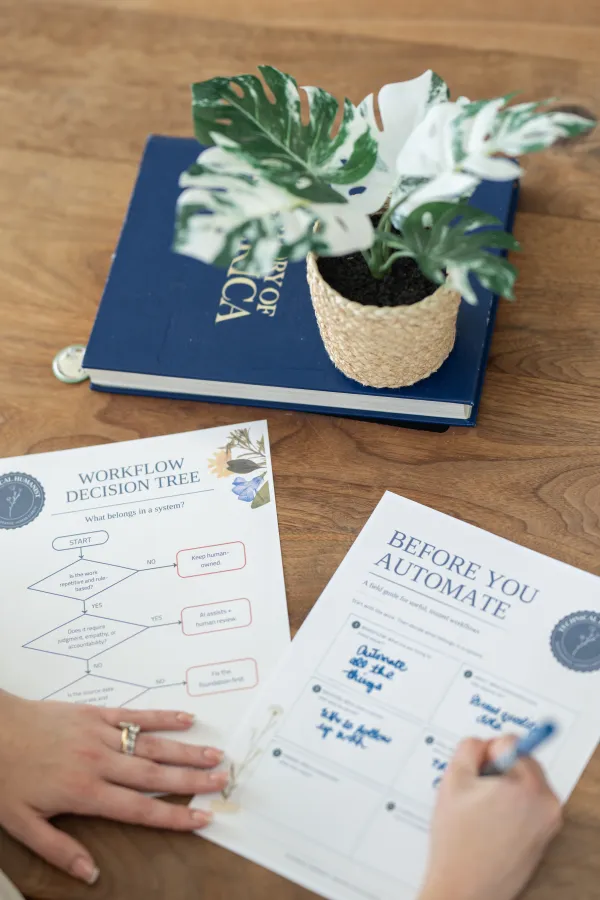

Operating principles
How I work, whatever the engagement.
These are working practices. The service stages on the Services page describe different engagement types; these hold across all of them.
- Evidence before opinionStart from what the work leaves behind.
- Reports, exports, prompts, process documents, outputs. Opinions about an AI effort come second, and they're checked against the evidence.
- The people doing the work are evidenceTalk to the people closest to it.
- The person who runs the workflow every week knows where it breaks. Their account is evidence too, and it's recorded as theirs.
- Find the primary blockerName one thing first.
- Every engagement ends with a single issue or step that comes before the others. The overall picture won't hide the issue that needs attention first.
- Leave something the team can useLeave something a team can run.
- A brief, a map, a specification, or a system, sized for a team without specialist support. What that artifact is depends on the agreed scope.
Four working moves
The same sequence, at any scale.
Understand the work
What the team is trying to do, who does it, and where the AI effort was supposed to help. In their words, before mine.
Leaves behind: a one-page statement of the problem everyone signs off on.
Check the evidence
Review what the work produces and what it depends on. Test each assumption against something that can be looked at.
Leaves behind: findings, each tied to an evidence item or an interview.
Choose the next step
Decide what deserves attention first and why it comes before the rest. Name the first dependency clearly, assign an owner, and sequence the next 90 days as real actions: early wins you can show, and the groundwork that makes the later ones possible.
Leaves behind: a named first step and the reasoning behind it.
Hand over something usable
Walk the team through what they’re receiving, prepare the version that goes to leadership, confirm who owns the next step, and leave them able to proceed without depending on me for routine interpretation.
Leaves behind: the artifact the scope agreed on, and a handoff session.

Sample outputs
What the moves leave behind.

Primary blocker
Campaign performance lives in three exports with no shared customer key. Every AI summary starts by reconciling them by hand.
First 90 days
- Weeks 1–3: agree one customer identifier
- Weeks 4–8: one joined weekly table, owned by marketing ops
- Weeks 9–12: rerun the summary pilot on that table
Output of an AI Foundation Diagnostic.
Future state · Weekly campaign summary
1 · Input
Exports to one folder, Monday 9am.
Marketing ops analyst
2 · Join
Match on customer ID. Unmatched to exceptions.
Automation
3 · Draft
Summary from the joined table only.
Automation
4 · Review
Approve, edit, or send back.
Marketing manager
Exception routeMore than 5% unmatched rows pauses the run and notifies the marketing ops analyst.
Output of a Workflow Design Sprint.
Who's responsible
A person keeps the decision.
Every workflow I design or build has a named human accountability model. Depending on the consequence of error, that may include individual review, exception routing, sampling, monitoring, rollback, or a clear pause-and-escalation path. The system does not outrun the people responsible for its consequences. Findings are recommendations; your team decides what to act on. When I build something, I say plainly what it does without a person and what it can’t.
Artifacts, documentation, and the automation itself are yours at handoff.
Data access
Only what we agree, only for the work.
Evidence items are agreed up front and shared the way your team already shares files. I don't need system logins for an assessment or a design. Anything sensitive can be redacted before it reaches me.
Builds use your licenses and your environment. Access rules are written into the specification before anything is connected.

Working with AI
Where AI fits, and where it doesn't.
The method above applies to any engagement. A separate page sets out how I use AI inside that method: what it's for, where judgment stays with a person, the boundaries I keep, and how client data is handled.
Read How I Work With AI →- “AI should support human capability. It should not be used to make human accountability disappear.”
- “AI doesn't earn its place by producing an answer quickly. It earns its place when it improves a defined workflow and makes the people involved more capable.”
- “I don't recommend AI for its own sake, and I don't sell work, tools, claims, or implementations I can't defend as solving your real problem.”
Across the services
Same method, different depth.

| Service | Where the evidence comes from | What you hand over to your team |
|---|---|---|
| Working Session | One 90-minute call. What you and the person who runs the workflow already know. | Completed worksheet, one named constraint, a first step with an owner. |
| AI Foundation Diagnostic | Up to ten agreed evidence items and four interviews. | Five-area findings brief, primary blocker, 90-day action plan. |
| Workflow Design Sprint | Two working sessions walking one workflow as it happens today. | Current and future-state map, build specification. |
| Automation Build | The approved specification, then testing against real inputs. | Working automation, documentation, training, operating guide. |
| AI Playbook Workshop | Sponsor intake and two of the team's own example workflows. | Written decisions, one pilot with a named owner and review date. |
| Ongoing AI Advisory | The proposal, workflow change, or question you bring each month. | A decision log: question, evidence, decision, owner, revisit date. |
| AI Search Visibility Assessment | 60 dated observations of AI answers and a review of up to 25 pages. A deeper tier covers 75 pages, 50 questions, three platforms, and two competitor benchmarks. | Query-level findings with source evidence, prioritized changes. |
- Where the evidence comes fromOne 90-minute call. What you and the person who runs the workflow already know.What you hand over to your teamCompleted worksheet, one named constraint, a first step with an owner.
- Where the evidence comes fromUp to ten agreed evidence items and four interviews.What you hand over to your teamFive-area findings brief, primary blocker, 90-day action plan.
- Where the evidence comes fromTwo working sessions walking one workflow as it happens today.What you hand over to your teamCurrent and future-state map, build specification.
- Where the evidence comes fromThe approved specification, then testing against real inputs.What you hand over to your teamWorking automation, documentation, training, operating guide.
- Where the evidence comes fromSponsor intake and two of the team's own example workflows.What you hand over to your teamWritten decisions, one pilot with a named owner and review date.
- Where the evidence comes fromThe proposal, workflow change, or question you bring each month.What you hand over to your teamA decision log: question, evidence, decision, owner, revisit date.
AI Search Visibility Assessment
Where the evidence comes from60 dated observations of AI answers and a review of up to 25 pages. A deeper tier covers 75 pages, 50 questions, three platforms, and two competitor benchmarks.What you hand over to your teamQuery-level findings with source evidence, prioritized changes.
Bring an assumption you'd like tested.
Free introductory conversation. No preparation required.
Book a 30-minute call